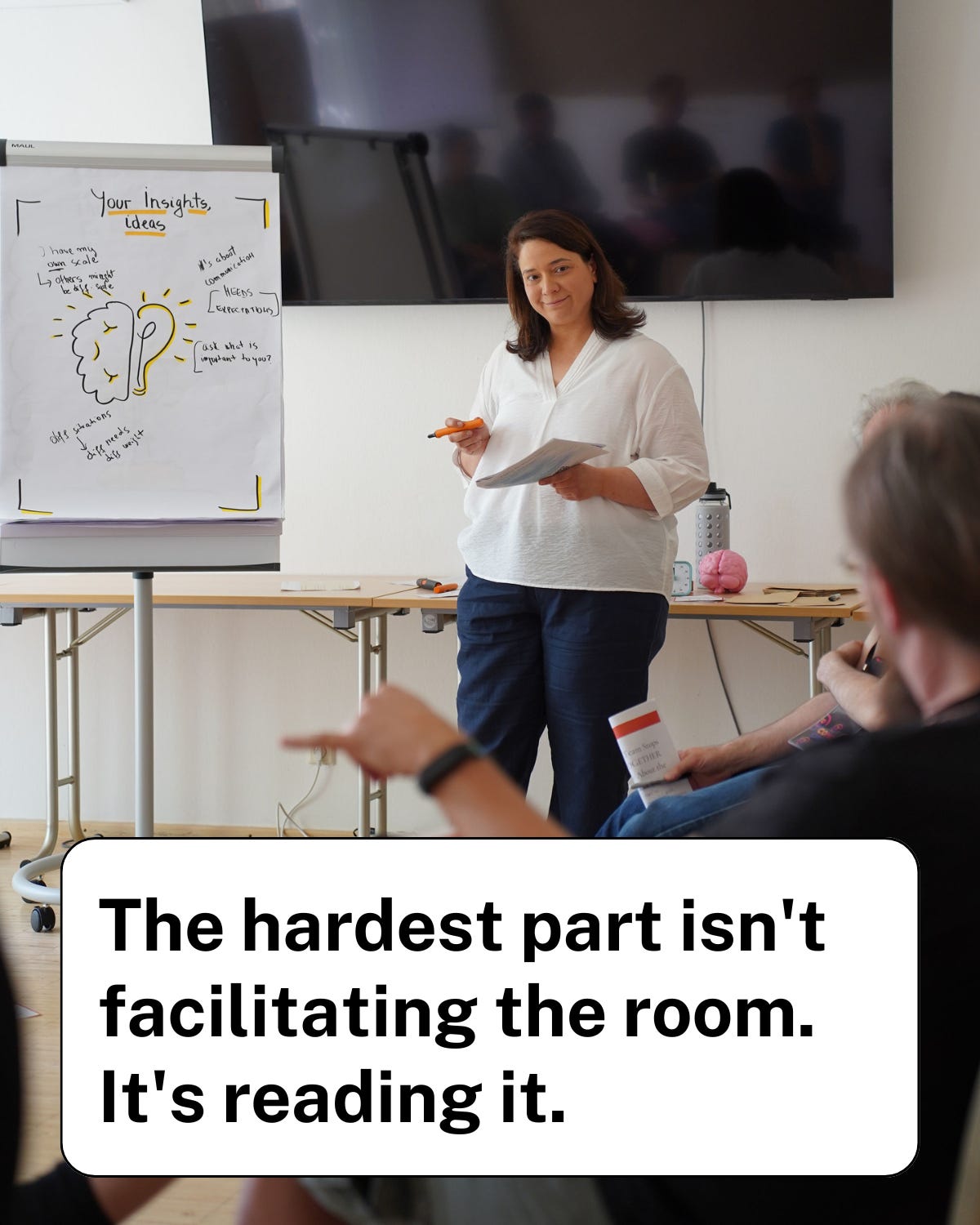
The hardest part isn't facilitating the room. It's reading it
Most facilitation challenges don't begin when someone interrupts, stays quiet, or disagrees.
Most facilitation challenges don't begin when someone interrupts, stays quiet, or disagrees.
They begin the moment we decide we already know what that behaviour means.
A quiet participant isn't always disengaged.
A difficult participant isn't always resistant.
A person who keeps talking isn't always trying to take over.
The same behaviour can come from completely different reasons.
And if the reason is different...the way you respond changes too.
That's why I've become less interested in asking,
"What's the right facilitation technique?"
and much more interested in asking,
"What am I actually seeing?"
Because once you see the room differently, you naturally facilitate differently.
That's what we'll explore together on 16 July.
Not another collection of facilitation tools.
A way to understand what's happening beneath the behaviour, so you can decide what deserves your attention when everything goes off-script.
No recording. No replay. Just you, fully present, with what’s real for you right now.
See you there.
Andra